

Summary
- First Impressions: A Thrilling Start
- Technical Specifications
- Design & Handling: A Familiar Yet Refined Evolution
- Display: Bright and Sharp, With Caveats
- Performance & Battery Life: Tensor G5 Shows That Efficiency Is True Power
- Camera: Can the Algorithm Outshine the Sensor?
- Software: Gemini intelligence at the core
- The Bottom Line
First Impressions: A Thrilling Start
In this Pixel 10 Review, we explain why the Google Pixel 10 isn’t just a simple evolution but a genuine gamble from Google. The Pixel 10 has surprised many while also upsetting part of its long-time community. Why? Because Google has changed the rules of the game.
If in previous years the Pixel series was seen as the perfect alternative for those looking for an excellent camera, clean software, and a “fair” price, now its market positioning is completely different. With a starting price of €899 for the 128 GB version and €999 for the 256 GB model, this device goes head-to-head with true flagships, competing directly with the Apple iPhone 16 and with last year’s Android flagships, which are often available at discounted prices.
Launch Prices – U.S.
Updated: Sep 6, 2025

This new positioning has raised some eyebrows. Some critics even call the price “crazy” and complain that Google is “becoming like Apple,” abandoning its niche as the “perfect middle ground.” The feeling is that Google no longer wants to be just a niche alternative, as it was with the Pixel 8 and Pixel 9, but a true competitor on par with the giants.
Such a strategy suggests that the company is betting not so much on hardware, but on the added value of its software and AI-driven features. The high upfront cost is justified by the all-around user experience and by the promise of 7 years of updates. The buyer is not just purchasing a phone, but a complete and long-lasting package—a long-term vision of what a smartphone should be. This is the concept Google wants to sell with the Pixel 10.
The Pixel 10 became available starting in August 2025, through major retailers and online channels.
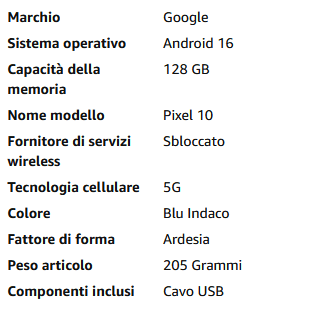
Technical Specifications

Display
Actua display, 160 mm
OLED 1080 x 2424
Processor
Google Tensor G5
Titan M2 security coprocessor
Memory
12 GB RAM
128 GB Storage
256 GB Storage
Cameras
48 MP (macro)
13 MP (ultrawide)
10.8 MP (Tele 5x)
10.5 MP Front Camera
Battery
4.970 mAh
Op System
Android 16
DImensions
204 g
152,8 x 72 x 8,6 mm
Connectivity
5G
Dual SIM (eSim+SIM)
Wi-Fi 6e
Our Take
The Google Pixel 10 is a phone of big compromises—but also big promises. It’s no longer the classic flagship killer, nor the best in every individual category. Yet its bet on artificial intelligence and longevity makes it a unique, bold product. Google hasn’t stepped back; it has changed course, doubling down on a vision of the smartphone that prioritizes intelligent integration over sheer brute force. The final verdict: the Pixel 10 is a mature device that’s worth considering—provided its vision aligns with your needs.
Design & Handling
Display
Performance
Cameras
Battery
Software
Value
Pros
Cons
Recommended for:
This phone is for anyone who wants a clean, fast, intelligent software experience where AI—and Gemini in particular—takes center stage. It’s ideal for the enthusiast photographer who wants a versatile camera with optical zoom without paying Pro-tier prices. It isn’t the phone for hardcore gamers or video-first creators, but it’s perfect if you use your smartphone for social, productivity, and photography. Finally, it makes sense if you see a phone as a long-term investment, backed by 7 years of updates. Pro tip: if you can, wait for post-launch deals or leverage a good trade-in, because the overall value improves dramatically.
Design & Handling: A Familiar Yet Refined Evolution
The design of the Google Pixel 10 is a refined reworking of the lines that have made the Pixel series instantly recognizable, with the iconic camera bar on the back that draws the eye and sets it apart from the crowd. The new color options—especially Jade (exclusive to the Pixel 10 Pro) with its golden accents—are elegant and understated, far from the risk of looking flashy. Even the Google logo, the iconic “G,” now comes with a new finish, adopting a metallic look with subtle reflections that many will appreciate.

The Google Pixel 10 is available in four color variants, ranging from classic to original:
- Obsidian Black – a deep, elegant black, perfect for those who love a timeless style.
- Lemongrass – a dark, natural green that feels understated yet distinctive.
- Frost – a delicate, creative shade, ideal for those who want a touch of personality.
- Indigo Blue – an intense blue with violet reflections, bold and modern.
This range of colors allows the Google Pixel 10 to move from a more elegant and professional look to younger and more creative options, while always maintaining a style consistent with the overall Pixel design language.
The build quality of the Google Pixel 10 is excellent. The frame is made of aerospace-grade aluminum and the back is protected by Corning Gorilla Glass Victus 2, ensuring durability and resistance to drops and scratches. The device also carries an IP68 certification, making it resistant to dust and water. The display bezels are another carefully designed detail: while not the thinnest on the market, they are perfectly symmetrical, a design choice that contributes to a clean and balanced aesthetic.

The most interesting innovation, however, isn’t aesthetic but functional: it’s called Pixel Snap. Google introduces a magnetic system built directly into the phone, working with the Qi2 wireless charging standard—a direct and mature response to Apple’s MagSafe. Compatibility with existing third-party accessories is a major advantage, allowing users to easily attach wireless chargers, mounts, and even add-ons like wallets.
This technology goes beyond simple wireless charging: Google is laying the foundation for a true ecosystem of accessories, something that has long been missing in the Android world. Combined with the promise of 7 years of updates, this strategic move transforms the Google Pixel 10 from a mere smartphone into a hub for a broader ecosystem of products and services.
Another positive note is the haptic feedback, with a vibration motor that delivers a precise and satisfying user experience, integrated into many system interactions.

Display: Bright and Sharp, With Caveats
The display of the Google Pixel 10 features a 6.3-inch OLED panel with a resolution of 1080 x 2424 pixels, protected by Corning Gorilla Glass Victus 2. Visual quality is excellent, offering vivid colors and full HDR support. The real highlight is peak brightness: reaching an impressive 3000 nits, the display remains perfectly readable even under direct sunlight, exceeding many expectations.

However, there’s a trade-off worth noting. While the Google Pixel 10 display supports a 120 Hz refresh rate, it lacks LTPO technology, a gap that sets it apart from the Pro models. Without LTPO, the refresh rate can only drop to 60 Hz, unlike the higher-end versions that can scale down to 1 Hz—a value that helps optimize power consumption during static situations, such as reading text or when using the Always-On Display.
| Feature | Without LTPO (e.g., Pixel 10) | With LTPO (e.g., Pixel 10 Pro) |
|---|---|---|
| Minimum refresh rate | 60 Hz | 1 Hz |
| Power efficiency | Higher idle power draw | Up to ~30% lower draw |
| Always-on display | Higher battery impact | More efficient and sustainable |
| Battery life | Good but not optimized | Longer at the same capacity |
| Panel cost | Lower (more affordable) | Higher (premium tech) |
This choice is a conscious compromise by Google, likely aimed at differentiating the models (the Pro version comes with LTPO) and keeping costs under control. The direct consequence impacts energy efficiency. Maintaining a minimum refresh rate of 60 Hz, even when no animations are running, results in higher battery consumption compared to what LTPO technology could achieve. While the battery life of the Google Pixel 10 is good, overall efficiency doesn’t reach the levels an LTPO panel would have provided. It’s a limitation that, while not affecting daily use, does penalize long-term battery performance.
Performance & Battery Life: Tensor G5 Shows That Efficiency Is True Power
At the heart of the Google Pixel 10 lies the new Tensor G5 chip, a crucial milestone for the entire Pixel series. For the first time, Google relies on TSMC and its 3nm manufacturing process, a move that promises to address the efficiency and heat management issues that plagued previous generations. The company claims significant improvements: the TPU (AI engine) delivers 60% more processing power, while the CPU is 34% faster. It’s worth noting, however, that Google isn’t aiming to win the “benchmark war” against Qualcomm or Apple chips.
| Feature | Tensor G5 (Pixel 10) | Tensor G4 (Pixel 9) | Top Snapdragon / Apple A-Series (current generation) |
|---|---|---|---|
| Key point | New generation focused on AI (TPU +60%, CPU +34%) | Previous gen; efficiency/thermals need improvement | Strong emphasis on peak performance / benchmarks |
| Foundry & process | TSMC – 3 nm | Older node (less advanced) | Latest processes (performance/efficiency focus) |
| CPU | +34% vs previous gen (claimed) | Series 9 baseline | Very strong in synthetic benchmarks |
| TPU / AI engine | +60% compute (claimed) — focus on on-device AI | Lower headroom for new AI models | High-performance NPUs/Neural Engines, benchmark-oriented |
| GPU / Gaming | PowerVR; +27% in benchmarks vs prior gen but heats up under load; compatibility varies | Mali; weaker in heavy games | Generally the reference for gaming and frame-rate stability |
| Efficiency / Thermals | Improved thanks to TSMC 3 nm; better real-world endurance | Historical issues with efficiency/temps | Highly efficient; optimized for peaks and sustained loads |
| Memory / Storage | 8 GB RAM is ample; rare write-speed anomaly reported (likely software fix) | Previous configs; no major changes | High, stable read/write speeds |
| Strategic positioning | An **AI-first** engine: prioritizes smart features | Transitioning to AI, limited by generation | Aim: benchmarks and peak performance |
* Quantitative figures (TPU +60%, CPU +34%, GPU +27% in benchmarks) refer to claims and observations cited in the review. Competitor entries are qualitative/indicative.
In everyday use, performance is excellent. App launches, multitasking, and web browsing are smooth and fast, and the 8 GB of RAM (though not always specified) feels more than sufficient. Despite the overall solid performance, some users have reported an anomaly in memory write speeds, which in certain cases dropped drastically. This issue is believed to be software-related and, as is often the case with the Pixel line, will likely be resolved with a future update.

The most controversial point concerns gaming. Google has abandoned the Mali GPU in favor of a new PowerVR architecture from Imagination Technologies. This shift has raised doubts within the community, especially regarding potential compatibility issues with certain titles that run poorly on PowerVR GPUs, such as Genshin Impact and games built on the Godot Engine. Early tests show a 27% increase in benchmark performance compared to the previous generation, but the phone tends to heat up quickly under load, compromising long-term stability. That said, popular titles like PUBG and Call of Duty Mobile run without issues.
This choice is a clear indication of Google’s strategy: the Pixel 10 is not meant to be a pure gaming phone, but rather a device optimized for AI performance. The decision not to compete directly on raw graphics benchmarks shows that the main investment has been directed elsewhere, reinforcing the identity of the Google Pixel 10 as a true “smart phone” rather than a portable console.
| Feature | Pixel 10 | Pixel 10 Pro | iPhone 16 Pro | Samsung Galaxy S25 |
|---|---|---|---|---|
| Battery | 4970 mAh | ~5050 mAh | ~3650 mAh* | ~4700 mAh* |
| Average endurance | Over 24 hours (mixed use) | Battery drain test: outlasts iPhone 16 Pro and S25 | Very good, optimized by iOS | Very good, solid endurance |
| Wired / wireless charging | 30W wired / 15W wireless | 30W wired / 15W wireless | ~35W wired / 15W MagSafe | 45W wired / 25W wireless |
| Full charge time | ~90 minutes | ~90 minutes | ~80 minutes | ~60 minutes |
| Reverse charging | Not available | Not available | Not available | Available |
* Indicative figures for iPhone 16 Pro and Galaxy S25 based on typical battery capacities. The highlighted row shows the Pixel 10’s main limitation: slower charging compared to competitors.
As for battery life, the 4970 mAh battery promises to last well over 24 hours of use. In real-world testing, the phone comfortably makes it through a full day of mixed usage. A battery drain test even showed that the Pixel 10 Pro (which shares the same chip and manufacturing process) outperformed the iPhone 16 Pro and the Samsung Galaxy S25, confirming the efficiency of the new Tensor G5 chip.
The real Achilles’ heel remains charging, capped at 30W wired and 15W wireless. A full charge takes about 90 minutes, which is quite long compared to Asian competitors, and there’s no support for reverse wireless charging.
Camera: Can the Algorithm Outshine the Sensor?
The camera system of the Google Pixel 10 marks a turning point, striking a balance between innovation and compromise. The major novelty is the introduction of a 5x telephoto lens, a feature appearing for the first time on a non-Pro model, bringing a level of shooting versatility that was previously unimaginable for the standard Pixel lineup.
| Feature | Google Pixel 10 | Google Pixel 9a |
|---|---|---|
| Telephoto | New 5× (first time on a non-Pro model) | Not available |
| Main sensor | 64 MP (same sensor as 9a) | 64 MP |
| Ultrawide | 13 MP (same sensor as 9a) | 13 MP |
| Front camera | 13 MP | 13 MP |
However, in order to keep the price competitive and make room for this new sensor, Google made a significant compromise: the main and ultrawide sensors are the same ones used in the Pixel 9a, last year’s budget model.
Despite this hardware downgrade, the magic of Google’s computational photography more than makes up for it. In daylight, the photos are excellent, with accurate colors, a wide dynamic range, and solid detail. The Night Sight mode remains one of the best in the industry, capturing sharp shots even in low-light conditions, and the Macro mode delivers equally impressive results.
And what about the zoom? Thanks to AI processing, photos zoomed up to 20x remain clean and virtually free of noise—an achievement that feels almost unbelievable for a device in this category.




Artificial intelligence doesn’t just enhance shots—it transforms the entire photography experience. Features like Camera Coach, powered by Gemini, suggest the best framing and lighting; Auto Best Take combines multiple shots to ensure everyone is smiling with eyes open in group photos; and conversational editing in Google Photos allows users to make complex adjustments with simple voice commands.

The vulnerability of this reliance on AI is that the algorithm isn’t always a sure thing: sometimes it works brilliantly, enhancing the photo, but other times it can even make it worse—like flipping a coin.
The video performance remains the true Achilles’ heel. While Google has worked on improving stabilization, overall video quality is still a step behind its direct competitors, particularly the iPhone. The Google Pixel 10 does not allow recording in 4K at 60 fps from all cameras, a limitation that causes an annoying quality “jump” during shooting.
For professionals and content creators, the iPhone remains the preferred choice thanks to its superior apps and video quality. Google has made a bet: it sacrificed the quality of the main sensor to deliver a feature—the optical zoom—that the average user perceives as more useful.
The effectiveness of this move will depend entirely on the consistency of Google’s software, which, as we’ve seen, is still not perfect.
Software: Gemini intelligence at the core
The software experience is, as always, the real strength of a Pixel. Based on Android 16, the operating system is clean, incredibly smooth, and enjoyable to use. But the real power lies in the deep integration of Google’s artificial intelligence. Gemini is not just an app—it’s built directly into the operating system.
| AI Feature | Description | Where it’s used |
|---|---|---|
| Gemini built into the system | A native AI assistant that understands context and surfaces actions or replies within the interface. | Operating system |
| Magic CueNew | Anticipates user needs and suggests contextual information or shortcuts in real time. | Operating system |
| Gemini LiveNew | Lets you converse with AI while sharing what you see through the camera. | Camera / System |
| Camera CoachNew | Suggests optimal framing and lighting for better shots. | Camera |
| Auto Best Take | Combines multiple photos so everyone has eyes open and a natural expression. | Camera |
| Conversational editingNew | Enables complex edits in Google Photos using voice or text prompts. | Google Photos |
| Super-Res Zoom up to 20× | AI processing that reconstructs detail in zoomed shots while reducing noise and quality loss. | Camera |
| Night Sight & Macro | Advanced computational photography for low light and close-ups with crisp detail and natural colors. | Camera |
| On-device processing | Many AI features run directly on the phone, improving speed and privacy. | System / Photos |
* Some AI features may not be available in all regions or languages at launch and will roll out over time.
The new AI features are designed to simplify everyday life, with tools like Magic Cue, which anticipates user needs by offering contextual information and actions, and Gemini Live, which allows real-time conversations with the AI by sharing what the camera sees. Many of these AI functions run directly on the device, ensuring both speed and privacy.
The single biggest strength, however, is the update policy. Google guarantees a full 7 years of operating system and security updates—a promise unmatched in the Android world, exponentially increasing the long-term value of the device.
| Device | OS updates | Security | Update cadence | Feature Drops / Major | Estimated end of support* |
|---|---|---|---|---|---|
| Google Pixel 10 | 7 years | 7 years | Monthly · annual major | Quarterly Feature Drops | 2032 |
| Google Pixel 10 Pro | 7 years | 7 years | Monthly | Quarterly Feature Drops | 2032 |
| Apple iPhone 16 Pro | Not specified | Not specified | Regular, fast | Annual iOS major | ~6+ years |
| Samsung Galaxy S25 | 7 years | 7 years | Monthly (flagship line) | Regular One UI releases | 2032 |
* Estimate based on 7 years from launch (2025). Apple entry reflects historical averages.
This guarantee transforms the Google Pixel 10 from a short-term purchase into a true long-term investment, an aspect that helps justify its high launch price.
There is, however, a drawback: many of the most revolutionary AI features are not available in all regions at launch. This creates a clear gap between the premium price being asked and the immediate value the consumer receives.
In essence, the user is buying a “long-term project” device, one that will improve over time with software updates. This highlights the strategic challenge for Google in launching a global product with a staggered rollout of features—an approach that may frustrate consumers who expect to have everything advertised right from day one.
Patience becomes a crucial factor in fully enjoying the potential of the device.
The Bottom Line
In the end, the Google Pixel 10 is a smartphone that divides opinions, yet at the same time represents a bold step toward the future that the company envisions: more AI, deeper software integration, and unmatched longevity in the Android landscape. It’s not the perfect device—nor does it aim to be—but rather a turning point for those looking for a phone that grows and improves over time.
If you’re after the best in computational photography, guaranteed updates, and a glimpse into the future of mobile AI, the Pixel 10 is a choice that makes sense today and will make even more sense tomorrow. The price is high and some features will roll out gradually, but if you’re willing to invest in Google’s vision, you’re buying far more than just a smartphone—you’re entering an ecosystem built to last.
Buy it if:
- You want the best of Google’s AI features and computational photography.
- Long-term software support (7 years) is a priority for you.
- You prefer a phone that improves over time rather than one that peaks on day one.
Don’t buy it if:
- You need fast charging and cutting-edge battery efficiency right now.
- Top-tier video quality is your main priority (look at the iPhone instead).
- You’re not comfortable paying a premium price for features that may roll out gradually.